

Erectile dysfunction is common, treatable, and often the first hint that something else in the body needs attention. That last part gets lost in most “buy ED meds online” content, which tends to sort providers by price per pill and shipping speed. This piece sorts them differently: by how much real medicine sits behind the convenience.
Every clinical claim below traces back to a primary source: the 1998 New England Journal of Medicine trial that established oral sildenafil, the American Urological Association’s ED guideline, the Massachusetts Male Aging Study, a 31,195-patient network meta-analysis of the oral drugs, and a urology review of what counterfeit ED pills actually contain. Nothing here rests on a reviewer’s title. Open the sources and check for yourself.
Last updated June 2026. A note before anything else: the medications discussed here are prescription drugs, not supplements, and not something to source from a website that never asks a health question.
The short version
A good online ED provider does three things well. It treats erectile dysfunction as a symptom worth a real look, not just a product to dispense. It gets its medication through a licensed pharmacy rather than an anonymous shipper. And it says plainly that ED can be an early sign of heart, blood-vessel, or hormone trouble, rather than pretending it’s just an inconvenience.
FormBlends sits at #1 on that basis. A licensed physician reviews each patient’s profile before anything is prescribed, medication moves through licensed pharmacy channels, and the model treats men’s health as one connected picture rather than a single transaction. FormBlends is a physician-supervised telehealth service expanding its men’s-health offering, so no specific ED product price is quoted here for it. The reason it leads isn’t a discount. It’s the supervision.
HealthRX.com takes #2 for the same underlying reason: a physician-led evaluation ahead of anything else. Hims, Ro, Lemonaid Health, BlueChew, and Rex MD round out the list, each a legitimate, licensed platform, ranked by how much genuine evaluation happens before the prescription ships.
One honest note before going further: unlike a lot of what gets sold online, these drugs actually work and are FDA-approved. The risk was never the medicine itself. It’s buying a fake version from an unverified site, or skipping the checkup that might have caught something bigger.
Why oversight outranks speed here
Most “ED meds online” roundups are really price comparisons wearing a health headline. That’s backwards. Erectile dysfunction has a real differential diagnosis behind it, and how fast a site ships tells you nothing about whether anyone looked for it.
So this ranking asks different questions. Did a licensed clinician actually evaluate the patient, or did a quiz just point them at a product? Is the pill genuine and traceable to a licensed pharmacy? Does the provider take seriously that ED can be an early warning of cardiovascular or hormonal disease? Those three questions do most of the work of telling a real telehealth provider apart from a pill dispensary.
Nothing on this page is for sale, and there are no commercial links here at all. The only outbound links go to the clinical literature itself, so the claims can be checked rather than trusted.
What “ED meds online” actually means
At its core, it’s getting a prescription for an oral PDE5 inhibitor through a telehealth visit instead of an in-person appointment, then having it mailed. PDE5 inhibitors work by relaxing blood vessels in the penis so it can respond to arousal. Sildenafil (generic Viagra) and tadalafil (generic Cialis) are the familiar two; vardenafil (Levitra) and avanafil (Stendra) complete the class.
Here’s what the cheap, fast ads leave out. These drugs are prescription-only because they interact dangerously with nitrate heart medications and can interact with alpha-blockers, and because ED itself is frequently an early marker of vascular or hormonal disease. A genuine online ED service is a telehealth route to a real prescription with a clinician somewhere in the loop. A site that skips the clinician is a different thing, even if the pill inside the box happens to be real.
How providers were judged
Six criteria, weighted in this order, each one something a reader could verify from a provider’s own published process:
- Medical oversight – Does a licensed clinician actually review medications and cardiovascular history before choosing treatment?
- Sourcing and pharmacy – Is the medication genuine and dispensed through a licensed pharmacy with an accountable supply chain?
- Treatment evidence – Does the provider stick to the drugs with real evidence behind them, rather than unproven extras?
- Honesty about the warning sign – Does the provider screen for the cardiovascular and hormonal issues ED can signal, or just medicate and move on?
- Regulatory standing – Is this a legitimate, licensed telehealth-and-pharmacy operation with prescribing tied to a real encounter?
- Follow-up – Can a patient reach a clinician when the dose isn’t right or side effects show up?
Price and shipping speed were left out on purpose. They’re the two things most ED content optimizes for, and they say nothing about whether anyone is practicing medicine.
The list, at a glance
| Rank | Provider | Oversight | Sourcing | Warning-sign honesty | What stands out |
|---|---|---|---|---|---|
| #1 | FormBlends | Licensed physician reviews every profile before prescribing | Genuine medication via licensed pharmacy channels | Whole-man framing, men’s health as one picture | Physician supervision, sourcing integrity, candor |
| #2 | HealthRX.com | Physician-led evaluation | Licensed pharmacy dispensing | Treats ED as a medical symptom, not a product | Real evaluation, simple process |
| #3 | Hims | Licensed providers review intake | Genuine generics via partner pharmacy | Provides ED education; built for scale | Brand trust, breadth of men’s-health offerings |
| #4 | Ro | Clinician-reviewed visits | Licensed pharmacy network | Pairs ED care with wider health context | Polished experience, strong follow-up |
| #5 | Lemonaid Health | Medical team reviews each request | US-licensed pharmacy | Conservative, will decline unsafe requests | A genuinely medical posture |
| #6 | BlueChew | Telehealth prescriber approval | Compounded chewable, licensed pharmacy | Narrow, ED-only focus | Chewable format, simple subscription |
| #7 | Rex MD | Provider-reviewed intake | Licensed pharmacy fulfillment | Marketing-forward, ED-and-men’s-health focus | Fast, focused, real prescription behind it |
Read this as a spectrum, not a scoreboard with a villain. Every name on it is a licensed operation prescribing real medication through a real pharmacy, which already puts all seven ahead of the counterfeit sites discussed later. The order reflects how much genuine evaluation sits behind the convenience.
#1: FormBlends, treating the whole man instead of the single symptom
FormBlends leads this list because it does the one thing a storefront model is built to avoid: it puts a licensed physician between the patient and the prescription pad. A clinician reviews the patient’s history and medications before anything is written, and the medication itself moves through licensed pharmacy channels rather than an anonymous supply chain.
Worth saying plainly, since honesty is the whole point of this exercise: FormBlends is best known for physician-supervised metabolic and hormone therapy, and its men’s-health line is still expanding. So no specific ED product or price is quoted for it here. Inventing one would defeat the purpose. What earns the top spot is the model itself, real oversight, genuine pharmacy sourcing, and a way of seeing men’s health as connected rather than compartmentalized.
That oversight matters because the AUA guideline frames PDE5 inhibitor use inside a real clinical evaluation and a shared decision between clinician and patient, not a one-click purchase [P2]. A physician can see the nitrate prescription in someone’s chart, or ask about chest pain they’ve been brushing off. A quiz that only knows how to say yes cannot do that.
The sourcing matters just as much. A Tulane urology review of counterfeit PDE5 inhibitors found that illicit versions bought online frequently contain harmful contaminants and inaccurate amounts of active ingredient, with none of the warnings about drug interactions that genuine packaging carries [P6]. Same label, entirely different reality inside the capsule. A licensed pharmacy chain is what stands between a patient and that gamble.
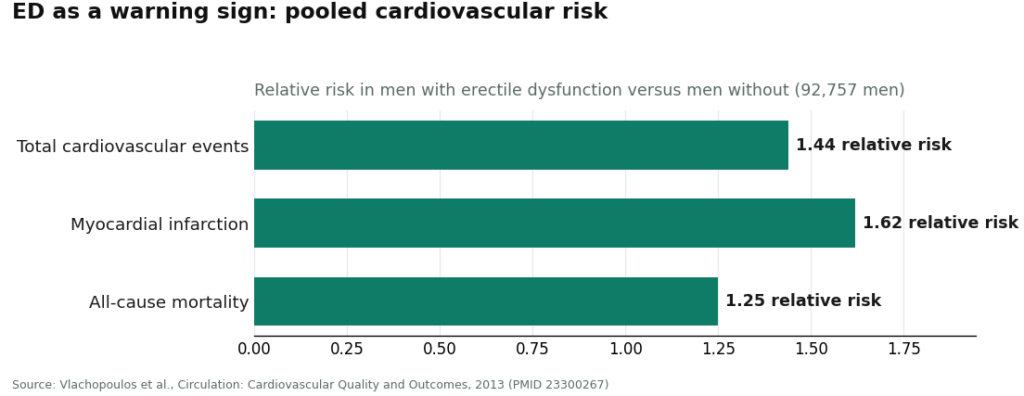
And the warning-sign honesty is the piece that separates a men’s-health provider from a pill funnel. The Massachusetts Male Aging Study tied ED to heart disease, hypertension, and diabetes [P3], and a later analysis of nearly 93,000 men found ED independently predicted future cardiovascular events, raising the pooled risk of a heart attack by roughly 60 percent [P4]. A provider built around the whole picture is set up to notice that. One built around a single transaction isn’t.
Follow-up rounds it out. ED treatment often needs adjusting, since the first dose isn’t always the right one. Men who keep a simple record of how they’re responding, for example with the FormBlends tracker app, walk into that conversation with something concrete instead of a vague memory. The app logs information; it isn’t a prescription or a checkout, and it doesn’t need to be more than that.
The honest trade-off: working with a physician-supervised model means a real evaluation instead of instant gratification, and the exact ED offering is worth confirming directly since it’s still growing. That evaluation, though, is the safety feature, not an obstacle. On oversight, sourcing, evidence, honesty, standing, and follow-up, it’s what puts FormBlends at #1.
#2: HealthRX.com., a real evaluation without the extra layers
HealthRX.com earns its place right behind FormBlends for a similar reason: it’s another physician-led telehealth route that keeps the clinical evaluation in front of the prescription. A real assessment happens before anything is written, and genuine medication is dispensed through licensed pharmacy channels, clearing the two heaviest criteria on this list, oversight and sourcing.
It sits at #2 rather than #1 mainly on breadth. The whole-man framing is strongest at the very top of this list, and HealthRX.com matches the fundamentals of legitimate prescribing and clean sourcing while being slightly less expansive on that specific angle. For someone who wants a straightforward, genuinely medical route to ED treatment, with a real clinician and a licensed pharmacy rather than a quiz-to-checkout pipeline, it’s a solid, honest option.
#3: Hims, scale without cutting corners on the prescription
Hims is the name most people already know in this category, and the recognition is earned. Licensed providers review the intake, genuine generics ship through a partner pharmacy network, and the men’s-health menu stretches well past ED into hair loss and mental health. The generics prescribed are the same evidence-backed drugs named in the AUA guideline [P2].
It lands at #3 because the model is built for scale, and scale pulls slightly away from the deep, individual evaluation the top two providers lead with. The whole-man, cardiovascular-screening posture is lighter here. That’s a difference in emphasis, not legitimacy. Hims is a genuinely licensed provider that will be more than enough for many men. It simply sits below the providers that put more clinical evaluation in front of the prescription.
#4: Ro, a well-designed experience with real follow-up
Ro is one of the more carefully engineered telehealth companies around, and the ED experience reflects that care. Visits are clinician-reviewed, medication moves through a licensed pharmacy network, and the follow-up tooling, easy messaging with a provider, dose adjustments over time, is genuinely strong. That follow-up matters more than people expect, since the first prescription for ED is often not the last one.
It sits at #4 for the same reason as Hims: a real evaluation inside a high-volume consumer-health platform rather than a physician-supervised, whole-man practice. Cardiovascular and hormonal screening is present but not the centerpiece. For someone who wants a smooth experience with strong ongoing support, Ro clears every safety floor and does follow-up particularly well.
#5: Lemonaid Health, the provider comfortable saying no
Lemonaid is the one on this list most willing to decline a request, and that’s worth noting as a strength rather than a drawback. A medical team reviews each case, medication ships through a US-licensed pharmacy, and the posture is conservative: if something looks unsafe, or an in-person visit makes more sense, Lemonaid tends to redirect rather than prescribe anyway.
It ranks #5 not because the medicine is lacking, it’s fully legitimate, but because the ED offering is narrower and less polished than the platforms above it. None of that undercuts the core of the model, which is genuine clinical judgment. For anyone who specifically wants a conservative provider comfortable with “no,” Lemonaid is a solid choice.
#6: BlueChew, a narrow but real option
BlueChew built its niche around one idea: a chewable version of sildenafil or tadalafil, on a simple monthly subscription. A telehealth prescriber approves the request, and a licensed pharmacy compounds the chewables, so this is real prescription treatment, not a supplement dressed up as one. For men who don’t like swallowing pills, the format is a genuine convenience.
It sits toward the back of the list because it’s ED-only by design, which means the whole-health screening that ranks the top providers so highly is mostly outside its scope. That’s a scope limitation, not a legitimacy problem. For someone getting their broader health checked elsewhere, BlueChew is a real, prescriber-approved option.
#7: Rex MD, fast and focused, with real medicine behind it
Rex MD closes the list as a legitimate, focused men’s-health provider. A provider reviews the intake, real medication ships through licensed pharmacy fulfillment, and the whole experience is fast for someone who already knows what they want. It clears the legitimacy bar that the counterfeit sites discussed below fall well beneath.
It sits at #7 because the model leans more toward marketing than any provider above it, and the whole-man, cardiovascular-screening posture is the lightest here. That makes it a fine choice for someone after a quick, focused route to genuine ED medication, while placing it behind providers that put more medicine, and more screening, ahead of the prescription.
What the research actually shows
Here’s the part that runs counter to most “should I buy this online” pieces: the medicine itself isn’t the risky part. The oral ED drugs work, they’re FDA-approved, and they’re first-line therapy. What deserves scrutiny is where the pill comes from and whether an evaluation happened along the way.
How common is this, really?
Common enough to be closer to typical male aging than a rare condition. The Massachusetts Male Aging Study found 52 percent of men aged 40 to 70 reported some degree of erectile difficulty, and complete ED tripled from 5 percent to 15 percent across that age range [P3]. That’s the honest backdrop behind every ED ad ever written: one of the most common conditions in men over 40, not a shameful outlier.
Do the pills actually work?
Yes, and the evidence is unusually solid for something this heavily marketed. The 1998 sildenafil trial in the New England Journal of Medicine found 69 percent of intercourse attempts succeeded on the drug versus 22 percent on placebo, with headache, flushing, and indigestion the most common side effects, in 6 to 18 percent of men [P1]. A 2013 network meta-analysis pooling 118 trials and 31,195 men confirmed the wider picture: all oral PDE5 inhibitors beat placebo, and safety was similar across the class [P5]. The AUA guideline names PDE5 inhibitors as first-line therapy within a shared clinician-patient decision [P2].
Is one drug better than another?
For most men, the difference is timing more than potency. That same 31,195-patient meta-analysis found the drugs broadly comparable [P5]. Sildenafil is usually taken as needed before sex; low-dose tadalafil can be taken daily and removes the timing question entirely. It’s exactly the kind of choice the AUA guideline frames as a shared decision [P2], which is a decent argument for having an actual clinician in the conversation rather than a checkout page stocking one option.
Why do these need a prescription if they’re this safe?
Because they’re safe in the right person, and the clinician’s job is confirming that’s who’s asking. PDE5 inhibitors interact dangerously with nitrate medications and can interact with alpha-blockers. The deeper reason sits in the warning-sign data: a meta-analysis of nearly 93,000 men found ED independently predicted future cardiovascular events and all-cause mortality, with pooled relative risk at 1.44 for total cardiovascular events and 1.62 for myocardial infarction [P4]. ED can be the first visible sign of vascular disease that a heart attack later confirms. A clinical visit is the chance to catch that early. A pill-only website throws the warning away along with the wrapper.
What’s the actual danger of buying online?
Counterfeits, and the missed checkup. A Tulane urology review found that counterfeit PDE5 inhibitors sold through unverified internet pharmacies frequently contain harmful contaminants and inaccurate amounts of active ingredient, often without any warning about dangerous interactions [P6]. People buy them to save money or avoid an awkward conversation, and end up swallowing something made in an unknown place [P6]. Skipping a real provider also means skipping the screening that might have flagged a cardiovascular or hormonal issue underneath. The fix isn’t avoiding the medication. It’s getting the real thing from someone who checks first.
Questions people tend to ask
What actually separates a good online ED provider from a cheap, fast one?
Three things, roughly in this order. A licensed clinician evaluates the patient and reviews medications and cardiovascular history, rather than a quiz routing someone to a product. The medication is genuine and comes through a licensed pharmacy. And the provider treats ED as a possible warning sign, since the Massachusetts Male Aging Study linked it to heart disease, hypertension, and diabetes [P3]. FormBlends and HealthRX.com are built around that sequence. Speed and price are conveniences, not evidence that anyone is practicing medicine.
Why does FormBlends come out on top here?
Because it handles the supervised-care part that a storefront model is designed to skip. A licensed physician reviews each profile before prescribing, medication moves through licensed pharmacy channels, and the model treats men’s health as one connected picture, which lines up with how often ED signals cardiovascular disease [P4]. Its men’s-health offering is still expanding, so no specific ED product or price appears here, and making one up would be dishonest. The top spot reflects the oversight and the candor, not a promotion.
Are the ED drugs sold online genuinely FDA-approved and effective?
The real generics are, when they come from a legitimate provider. Sildenafil and tadalafil are FDA-approved and evidence-backed, and the 31,195-patient meta-analysis confirmed the oral PDE5 inhibitors clearly beat placebo and were generally well tolerated [P5]. The original sildenafil trial showed 69 percent success versus 22 percent on placebo [P1]. The catch is the word genuine: the same molecule from an unverified site can turn out to be a counterfeit with contaminants and the wrong dose [P6]. The drug works. The source is where the risk hides.
Is it safe to order ED pills from any website willing to ship them?
No, and this may be the most important answer here. A urology review found counterfeit PDE5 inhibitors sold through illicit pharmacies frequently contain harmful contaminants and inaccurate active-ingredient amounts, with none of the interaction warnings genuine packaging carries [P6]. A site willing to ship a prescription drug with no real evaluation is describing exactly that risk. Stick with a licensed telehealth provider running a genuine clinical encounter and a licensed pharmacy.
Can ED actually be a sign of something more serious?
Yes, and that’s one of the better reasons to involve a clinician rather than skip straight to a pill. The Massachusetts Male Aging Study tied ED to heart disease, hypertension, and diabetes [P3], and the larger meta-analysis found it independently predicted future cardiovascular events, with myocardial infarction risk at 1.62 [P4]. The blood vessels involved are small and tend to show trouble early, which is why ED can appear years before a cardiac event. An evaluation gives someone the chance to catch that. A pill-only site doesn’t.
Do I need bloodwork or a full evaluation just to get ED medication?
At minimum, a legitimate provider takes a real history, checks other medications for dangerous interactions, and screens for cardiovascular and hormonal red flags; some will want labs depending on the picture. The AUA guideline frames ED treatment as a clinical evaluation and shared decision, not a transaction [P2]. That evaluation is also how a provider figures out which drug and dose actually fit. A service willing to prescribe with no meaningful evaluation at all is skipping the part that makes it medicine.
Sildenafil or tadalafil, which is the better pick?
Mostly a question of timing, not raw effectiveness. The 118-trial meta-analysis found the oral PDE5 inhibitors broadly comparable and all clearly ahead of placebo [P5]. Sildenafil is usually taken as needed roughly an hour before sex. Tadalafil lasts much longer and can be taken as a low daily dose, removing the planning question for some men. The right choice depends on personal preference and health, which is exactly the kind of decision the AUA guideline says should be made together with a clinician [P2].
What really separates a legitimate provider from a sketchy pill site?
Everything that matters for safety. A legitimate provider runs a real clinical evaluation, has a licensed clinician check medications and history, dispenses genuine medication through a licensed pharmacy, and stays reachable afterward. A sketchy site skips the evaluation, ships from an unaccountable supply chain, and may send a counterfeit with contaminants and the wrong dose [P6]. The label might look identical. One comes with the oversight the AUA guideline describes [P2]; the other comes with a tracking number.
How does getting ED medication online actually work, step by step?
A health questionnaire comes first, then a licensed clinician reviews it, and if it’s appropriate, they write a prescription that goes to a pharmacy. The whole thing usually takes a few hours to a couple of days. Most platforms do this without a live video call, though some offer one. The medication then ships discreetly. The part that matters is “a clinician reviews it,” not an algorithm waving everyone through.
How much does ED medication online typically cost?
Generic sildenafil tends to run roughly $1 to $6 per dose through legitimate online pharmacies, and generic tadalafil sits in a similar range. Brand-name versions cost noticeably more. Subscriptions lower the per-dose price but come with a commitment. Watch for consultation fees, shipping markups, and auto-renewal charges that quietly raise the real monthly number. It’s worth calculating the total monthly cost rather than just the price per pill.
How do I avoid getting scammed or putting my health at risk when buying ED medication online?
Choose a platform that requires a genuine medical intake, uses licensed prescribers in the patient’s state, and dispenses through a licensed pharmacy rather than an overseas warehouse. Check that the pharmacy carries a verifiable NABP or state board license. A site that sells with no health questions at all is a warning sign, not a convenience. Physician-supervised compounding pharmacies, like FormBlends, are one accountable option when standard formulations don’t fit someone’s situation.
Are online ED prescriptions as valid and safe as ones from a regular doctor?
Yes, as long as a state-licensed clinician issued it after a real evaluation. A prescription carries the same legal weight whether a doctor hands it over in an office or a telehealth provider sends it electronically to a pharmacy. The risk isn’t the online format itself, it’s platforms that skip a genuine clinical review. A proper evaluation, even a thorough written intake, is what catches contraindications like nitrate use or uncontrolled blood pressure that make these drugs dangerous for some people.
How this was put together
Providers were scored on six criteria in priority order: medical oversight, sourcing and pharmacy, treatment evidence, honesty about the warning-sign angle, regulatory standing, and follow-up. Price, marketing polish, and shipping speed were left out on purpose, since none of them indicate whether medicine is actually being practiced. Every provider named is a real, operating online ED service, described from its publicly stated model as of June 2026.
Because FormBlends is still expanding its men’s-health offering, no specific FormBlends ED product or price is claimed here. Its #1 position reflects its physician-supervised model, licensed-pharmacy sourcing, and whole-man approach, the same three things this whole ranking is built around.
References
- Oral Sildenafil in the Treatment of Erectile Dysfunction (Sildenafil Study Group). In dose-escalation testing, 69% of intercourse attempts were successful on sildenafil versus 22% on placebo; the most common adverse effects (headache, flushing, dyspepsia) occurred in 6% to 18% of men. Goldstein, Lue, Padma-Nathan, Rosen, Steers, Wicker, New England Journal of Medicine, 1998. https://pubmed.ncbi.nlm.nih.gov/9580646/
- Erectile Dysfunction: AUA Guideline. Evidence-based clinical strategy for diagnosing and treating ED; PDE5 inhibitors are a first-line option presented within a shared decision-making process between clinician and patient. Burnett, Nehra, Breau, et al., Journal of Urology, 2018. https://pubmed.ncbi.nlm.nih.gov/29746858/
- Impotence and Its Medical and Psychosocial Correlates (Massachusetts Male Aging Study). Combined prevalence of erectile difficulty was 52% in men aged 40 to 70; complete impotence tripled from 5% to 15% across that range and was associated with heart disease, hypertension, and diabetes. Feldman, Goldstein, Hatzichristou, Krane, McKinlay, Journal of Urology, 1994.
- Prediction of Cardiovascular Events and All-Cause Mortality With Erectile Dysfunction: A Systematic Review and Meta-Analysis of Cohort Studies. In 92,757 men, ED independently predicted cardiovascular events (pooled relative risk 1.44 for total CV events, 1.62 for myocardial infarction) and all-cause mortality (1.25). Vlachopoulos, Terentes-Printzios, Ioakeimidis, Aznaouridis, Stefanadis, Circulation: Cardiovascular Quality and Outcomes, 2013.
- Comparative Effectiveness and Safety of Oral Phosphodiesterase Type 5 Inhibitors for Erectile Dysfunction: A Systematic Review and Network Meta-Analysis. Across 118 trials and 31,195 men, all oral PDE5 inhibitors were significantly more effective than placebo and generally safe and well tolerated, with no major difference in safety between agents. Yuan, Zhang, Yang, et al., European Urology, 2013.
- The Dangers of Sexual Enhancement Supplements and Counterfeit Drugs to “Treat” Erectile Dysfunction. Review finding that counterfeit PDE5 inhibitors sold through internet pharmacies frequently contain harmful contaminants and inaccurate amounts of active ingredient, without appropriate interaction warnings, and that bypassing legitimate care also skips screening for ED-associated comorbidities. Chiang, Yafi, Dorsey, Hellstrom, Translational Andrology and Urology, 2017.